Keynote: Eva von Redecker

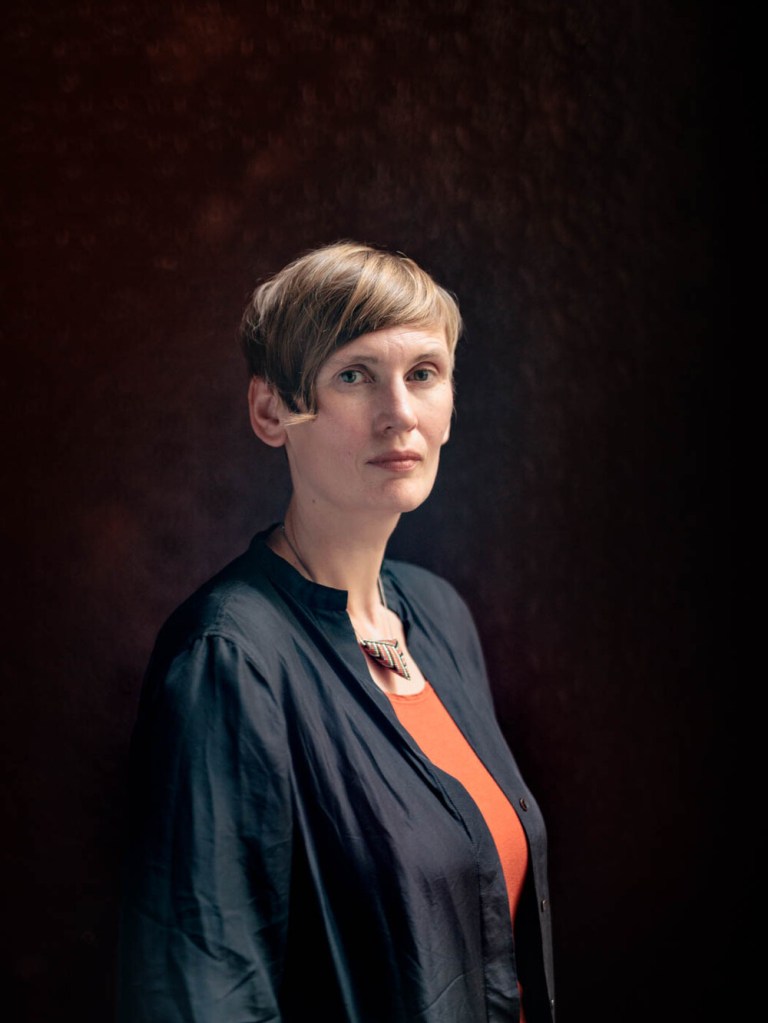
As the 11th annual conference of the Danish Society for Marxist Studies, Freedom, approaces, we are proud to announce the second of this year’s two keynotes: Eva von Redecker.

Redecker is a German philosopher, critical theorist, and bestselling non-fiction author based in rural Brandenburg.

Redecker’s work focuses on social praxis, feminism, critique of capitalism, freedom, and authoritarianism. Her most recent work includes books on the new fascism (Dieser Drang nach Härte, S. Fischer Verlage, 2026) and the freedom to stay (Bleibefreiheit, S. Fischer Verlage, 2025), and her books, in which she tracks the genealogy of modern property in contemporary violence, have been translated into 15 languages. The Freedom to Stay (Polity, 2026) proposes to understand freedom in a temporal way – as enjoyment of fulfilled time. Receker’s dissertation, Praxis and Revolution, came out with Columbia University Press in 2021. Her public writing has also appeared in The Guardian, le monde diplomatique and Die ZEIT.

In the academic year 2026/27, Eva holds a guest professorship for philosophy at the Academy for Fine Arts, Hamburg (HfbK). She is currently working on an epic poem about fossil energy.

At the conference, Redecker will present a keynote based on her recent book on the freedom to stay:

The Freedom to Stay. On Emancipation from Negative Liberty.

As a philosophical effort, critical theory does not just scandalize cruelty and suffering. It investigates how those are systemically produced, and points out how sometimes even our most progressive achievements cover up, or contribute to, injustice and oppression. In On The Jewish Question, Karl Marx famously criticized bourgeois freedom, newly won in the course of the French Revolution, as alienating and atomizing. Fast forwarding into our present, we witness that beyond ongoing capitalist rule, liberal orders facilitate a fascist turn. Around the globe, in the wake of neoliberalism, at the dawn of the Anthropocene, the appeal to “freedom” fuels fascist mobilizations. To understand this effect, we need to renew our critique of liberal freedom. It is not just egotistic, it is in fact possessive and easily breaks up into destructiveness. Emancipation into liberal self-ownership is not enough to extricate liberty from its abusive underside. Only by negating the abstract spaciality of possession can freedom turn social and ecological. I call the ensuing perspective that of a “freedom to stay”: the right of species and people alike to flourish, and the promise of fulfilled and abundant time rather than mere mobility on a dying planet.

Registration is open for the 11th conference!

With summer hastely closing on us, it’s time to start planning the fall – and why not begin by registering for the top Danish Marxism conference of the year?

Registration is now open for our 11th annual conference, Freedom, which will take place in Copenhagen 2-3 October 2026, including registration for the conference diner (limited availability)!

Click the image to register.

Keynote: Rob Knox

As the 11th annual conference of the Danish Society for Marxist Studies, Freedom, approaces, we are proud to announce the first of this year’s two keynotes: Robert Knox.

Rob Knox is a senior lecturer in Law at the University of Liverpool and a member of the editorial board for the renowned journal of Marxist theory, Historical Materialism. His research interests lie in critical and Marxist legal theory, focusing on imperialism and its relationship with International law. More recently, his work has focused on Palestine and on Marxist approaches to analysing the EU.

Together with Adam Hanieh and Rafeef Ziadah her recently published the book Resisting Erasure: Capital, Imperialism and Race in Palestine (Verso, 2025), in which they challene mainstream narratives about Palestine by placing Israeli settler-colonialism within the broader historical arc of imperialism, race, and fossil capitalism in the Middle East.

Together with Christine Schwöbel-Patel, Knox has also edited the anthology Aesthetics and Counter-Aesthetics of International Justice (Counterpress, 2024) on international law and aesthetics.

At the conference, Knox will present a keynote talk on Palestinian liberation and international law:

Palestinian Liberation, Racialisation and the Limits of International Law

Liberal invocations of freedom have typically been coupled with an expansive conception for the law. Law, and in political rights, are seen as the way to guarantee individuals with the widest degree of freedom from interference. Such a position has, of course, been frequently contested by Marxists – and indeed by Marx himself – who have often noted the bourgeois nature of this freedom.

In the current conjuncture, many have baulked at this analysis. In an increasingly vulgar capitalism, in which the ‘legal order’ is often understood as collapsing, law – especially international law – has appeared to offer a ‘site of struggle’ . Nowhere has this been clearer in the case of Palestine, where international law, especially in its explicit condemnation of genocide, has appeared to at least offer a defensive bulwark against an openly racist Israeli Zionism and US imperialism.

In this paper, I seek to reflect on this, situating (international law) within broader Marxist understandings of the history and nature of capitalism. I argue that international law has articulated a particularly racialised and bourgeois notion of ‘freedom’, which fundamentally conditions its existence as a ‘site of struggle’. In so doing, I explore the role that international law has played in the racialisation of Palestine, as well as its role in facilitating the expansion and consolidation of the Israeli state and its racial projects. It is only in such an analytical context, I argue, that we can understand both the possibilities and limits of international law in the struggle for Palestinian liberation.

Call for Abstracts: 11th annual conference

Freedom

Eleventh annual conference of the Danish Society for Marxist Studies

Copenhagen Business School, Denmark
2-3 October 202
6

Open call

While we particularly encourage engagements with the theme of “Freedom” for this year’s conference, we also welcome papers on any number of topics that contribute to critical research and radical scholarhip thereby enrichinging the Marxist tradition by expanding its range of interlocutors.

The most urgent political struggle of our time is a struggle for freedom: The struggle for a free Palestine. For the 11th annual conference of the Danish Society for Marxist Studies, the theme is freedom. With its rejection of bourgeois freedom, the Marxist tradition might be thought to be uninterested in the question of freedom altogether. However, Marx’s writings and the history of communist struggle offers several articulations of the meaning of freedom. With this year’s conference, we are interested in exploring distinctly communist conceptions of freedom that arise from within the Marxist tradition and how they are articulated in and informed by concrete struggles today. 

Throughout history, we have seen struggles for freedom take the shape of anti-imperialist, anti-capitalist, and anti-fascist struggles. What can be learned from the tools, analyses and tactics developed in these struggles? Drawing on the abolitionist notion that freedom is a place, it becomes clear that communist struggles are inherently entwined with building, sustaining, and organizing places free from state violence and exploitation. From the Paris Commune to Rojava, building revolutionary places of freedom entails a radical restructuring of life as we know it, revealing the possibility of new potential forms of freedom in social and intimate relations.

While it is a central task for radical scholarship to excavate and develop positive notions of freedom from communist struggles and Marxist lineages, it is also relevant to consider how freedom is invoked in the name of unfreedom. This is particularly relevant today, where liberal democracies cement state power by expanding settler colonial projects and carceral infrastructures, attacking labor and bodily autonomy, and reconfiguring technological and military power. Contemporary fascisms need to be read in terms of this specific conjuncture, while remaining mindful that pockets of fascism have always been embedded within the liberal state, as black radical scholars have consistently emphasized. 

Similarly, appeals to freedom are central to a range of contemporary reactionary and fascist mobilisations; fascist projects offer permission to dominate for the racially privileged few, while trad wives claim the ‘freedom’ to reject liberal feminism’s (failed) promise of gender equality. These affective appeals to freedom reveal something about the profound longing for freedom under capitalism, which we should take seriously, while at the same time rejecting them as dangerous dead-ends on the way to liberated life.

This year’s conference invites papers that engage with topics such as (but not limited to):

  • Specifically communist ideas of freedom and their articulation in concrete historical and contemporary emancipatory struggles 
  • Global struggles against imperialist expansion, colonial war, and authoritarian regimes 
  • The carceral state and infrastructures of unfreedom such as borders, prisons, walls and camps 
  • Struggles for bodily autonomy, such as trans liberation, abortion access, reproductive justice, and children’s liberation, and the ways in which these might inform a communist vision of freedom
  • Abolition, marronage and fugitivity as visions, strategies and histories of emancipation
  • Fascist fantasies of freedom, their mobilizing and affective appeal, as well as their implications for antifascist strategy
  • Freedom in relation to care and care labour; the relation between care and coercion, feminist struggles read as struggles for the freedom to care, analysis of struggles for freedom from care
  • Marxist feminist formulations of freedom vis-à-vis the liberal feminist promise of choice
  • State repression, surveillance and the use of law against political movements and dissidents, and counter-tactics claiming the freedom to assemble and organize
  • Love, sex and intimacy under capitalism, interrogations of liberal concepts of free love, and communist prospects for emancipated life through new intimacies and ‘comradely love’
  • Technology, such as the production, use and importance of technologies within and against capitalist social systems, in projects of unfreedom, or emancipatory struggles
  • Marxist visions of freedom and perspectives on the future, utopianism, alternatives, and transitions

Please submit your abstract (max. 250 words) through this form by 1 May 2026. Abstracts and presentations may be in Danish or English.

Please note

The conference is in-person only, and it will not be possible to present virtually. Attendance is free but requires registration beforehand. Please note that we are unable to provide financial support or travel reimbursement for participants. Participation in the conference dinner is only possible with pre-payment at registration. Registration will open soon.

The Danish Society for Marxist Studies (Danish: Selskab for Marxistiske Studier, SMS) is an independent academic society in Denmark. The purpose of the society is to promote interest and research in Marxism and other strands of critical thought and radical scholarship at Danish universities and institutes of higher learning, especially among early career scholars. We understand ‘Marxism’ in the broadest possible sense of the term as the critical tradition emanating from Marx’s thought in its entire historical and theoretical breadth and depth, and SMS is not committed to any one particular theoretical or political position.